
James Finnie
An imagined open-air studio overlooking a mountain lake, with a computer on an oak desk.

Product Manager — Fintech, AI & Customer Experience

Making complex products
feel simple.

I’m a product manager working across fintech, AI and customer experience, connecting customer needs with clear product direction.

Keep scrolling

James Finnie.

About

Clear direction for complex products.

Five years in regulated fintech — payments, trading and wealth — with a focus on product judgement, AI and customer experience.

My work connects customer needs, complex systems and product decisions. I use research, data and hands-on exploration to shape direction and test ideas. The projects below show that thinking in practice, including independently developed prototypes.

  • Now Senior Product Manager, AI & Personalization at CIBC Investor’s Edge
  • Based Toronto, ON — remote across Canada · Canadian PR
  • Domains AI agents · investing & wealth · payments · trading · connected health

Selected work

Selected projects and product thinking.

Three independent projects, with the thinking and systems behind them. Open a case study before exploring the prototype.

  1. Independent · live

    FinanceHermes

    A financial-research agent that searches the web and produces cited answers in a streaming interface.

    SSE streaming · tool loop · citation enforcement · serverless

  2. Independent · live prototype

    The Six Cut

    A map-first guide to Toronto’s independent butchers, with a transparent review-based scoring method.

    Next.js · Vercel · scoring methodology

  3. Personal build · wider vision

    Context systems

    My personal markdown knowledge system, and how I think the same idea should grow into organisationally owned employee and client context.

    Linked markdown · OKF · organisational context

  4. Product approach · illustrative

    AI-assisted product discovery

    Use AI to explore a product question, sketch possible solutions and build a lightweight prototype. Keep people involved in reviewing the evidence and deciding what is worth pursuing.

    Product discovery · prototyping · human review

  5. Product approach · illustrative

    Relevant customer experiences

    Start with a customer need, form a clear hypothesis and test whether a more relevant experience helps. Evaluate usefulness and respect customer preferences before expanding an approach.

    Personalization · experimentation · customer experience

FinanceHermes

01 / What I built

A research question becomes a visible workflow.

FinanceHermes is an independent financial-research and education prototype. A user asks a question, the agent chooses tools, reads source material and streams its activity before returning a source-linked answer. The interface makes the research process inspectable instead of showing only a final block of text.

Research mode combines model reasoning with web search and page extraction. Learn mode narrows the available tools to a curated educational library. They share the same agent endpoint but have different tool permissions and run budgets.

02 / How the system works

A small stack, with the orchestration made explicit.

  1. Browser → serverless endpointStatic HTML, CSS and JavaScript send the question to a Node.js function on Vercel. The project declares no npm dependencies; provider credentials stay server-side.
  2. Model → tools → modelThe server calls an OpenAI-compatible model provider, reconstructs streamed tool-call arguments, runs approved tools and returns their results to the model. It supports structured calls and Hermes-style inline calls.
  3. Streaming → final synthesisServer-Sent Events carry status, output and tool activity to the browser. Separate timeouts and step limits bound a run before final synthesis.

03 / Grounding and quality checks

Retrieval and citations are part of the implementation.

Research uses Tavily-backed search and extraction when configured. The local learning library uses keyword ranking with stemming, title weighting and phrase bonuses. A deterministic final pass checks educational links against the library and repairs plausible but nonexistent article paths.

An offline mock harness exercises the real agent loop against controlled upstream responses, including tool-call formats, streaming events, missing credentials, Learn restrictions, link repair and optional access-code gating.

This is a research and education demo, not financial advice. A linked source is not a guarantee of accuracy. Live research depends on configured services; educational content needs review and refresh. The access-code gate is not a subscription billing system.

Build references

Agent orchestrationStreaming, provider integration, tool execution and bounded runs. Retrieval and link validationThe educational search and source-link checks behind the experience.

04 / The interface

Start with the question.

Actual FinanceHermes research composer with a market-question field, Ask button and example prompts.
The live research composer, before a query is submitted. A focused crop of the actual interface; no generated answer is shown.

The Six Cut

01 / What I built

Find a local butcher, then understand the score.

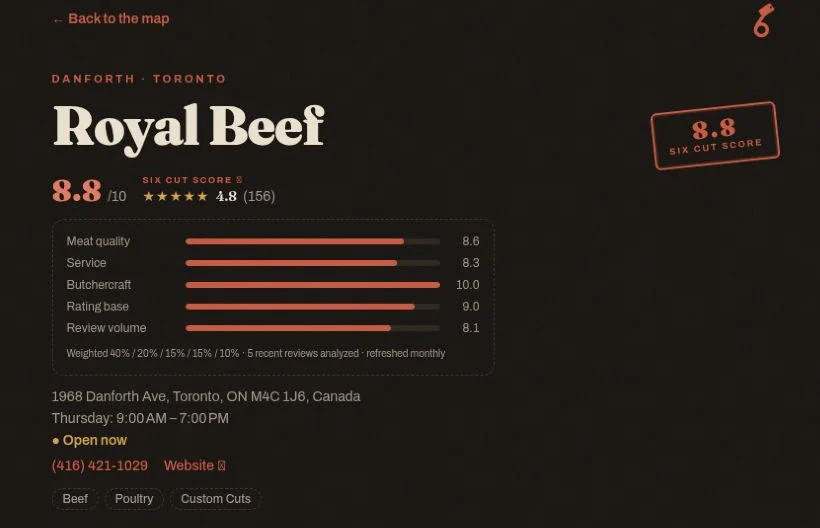
The Six Cut is a Toronto-focused discovery product for independent butcher shops. It brings location, specialties, opening hours, shop details and ratings into a map-and-list experience, with an explainable score alongside the underlying information.

Users can search, filter and compare shops, then open a profile for the score breakdown, contact details and available imagery. The score is intended as a useful comparison signal, with its method exposed for readers to question.

02 / The build

Discovery, structured data, and a resilient interface.

  1. Discover and cleanGoogle Places discovery scripts search overlapping areas across Toronto, deduplicate by place ID and filter named chains and non-operational businesses. Neighborhoods are assigned approximately from location.
  2. Store and serveSupabase/Postgres holds published shop data. Server routes resolve Google photo references and reviews without exposing the service key to the browser.
  3. Explore and compareNext.js, React and TypeScript power the product, with Mapbox for map browsing and filters for text, specialty, opening status and score. If the map cannot initialise, the interface falls back to a list.

03 / The scoring method

Weighted signals, with the ingredients visible.

The Six Cut Score uses deterministic review-text heuristics rather than an LLM making a subjective judgement. A lexicon finds positive and negative signals for quality, service and butcher craft, then combines them with the Google rating and review volume.

  • 40% · QualityReview-text signals about meat quality.
  • 20% · ServiceSignals about the customer experience.
  • 15% · CraftMarkers of specialist butcher skills.
  • 25% · Rating + volume15% normalised rating and 10% logarithmic review volume.

The implementation smooths positive/negative ratios, caps repeated matches and reduces the weight of text components when the review sample is small. Refresh runs combine currently returned reviews with previously observed signal counts in a recent window; the archive stores derived signals rather than raw review text.

Google supplies a limited review sample. Heuristics can miss context, language nuances and sarcasm, so the score is not a comprehensive quality judgement. Refresh tooling exists; a reliably scheduled refresh is not claimed here.

Build references

Read the scoring methodologyThe public explanation of the components and weighting. Inspect the scoring implementationDeterministic lexicons, weighting, smoothing and sample handling.

04 / The interface

Make the result explainable.

Actual Six Cut shop profile for Royal Beef showing its overall score, component bars, rating, contact details and specialties.
Shop profile and score breakdown, captured from the live prototype. This is a cropped view of the actual interface; displayed scores and shop details may change.

Context systems

01 / Personal build

Knowledge that carries between conversations.

My personal knowledge base is a set of cross-linked markdown notes used as shared context by Claude Code and the other agents I work with. It gives me something persistent to revisit and connect, rather than leaving everything inside individual chats.

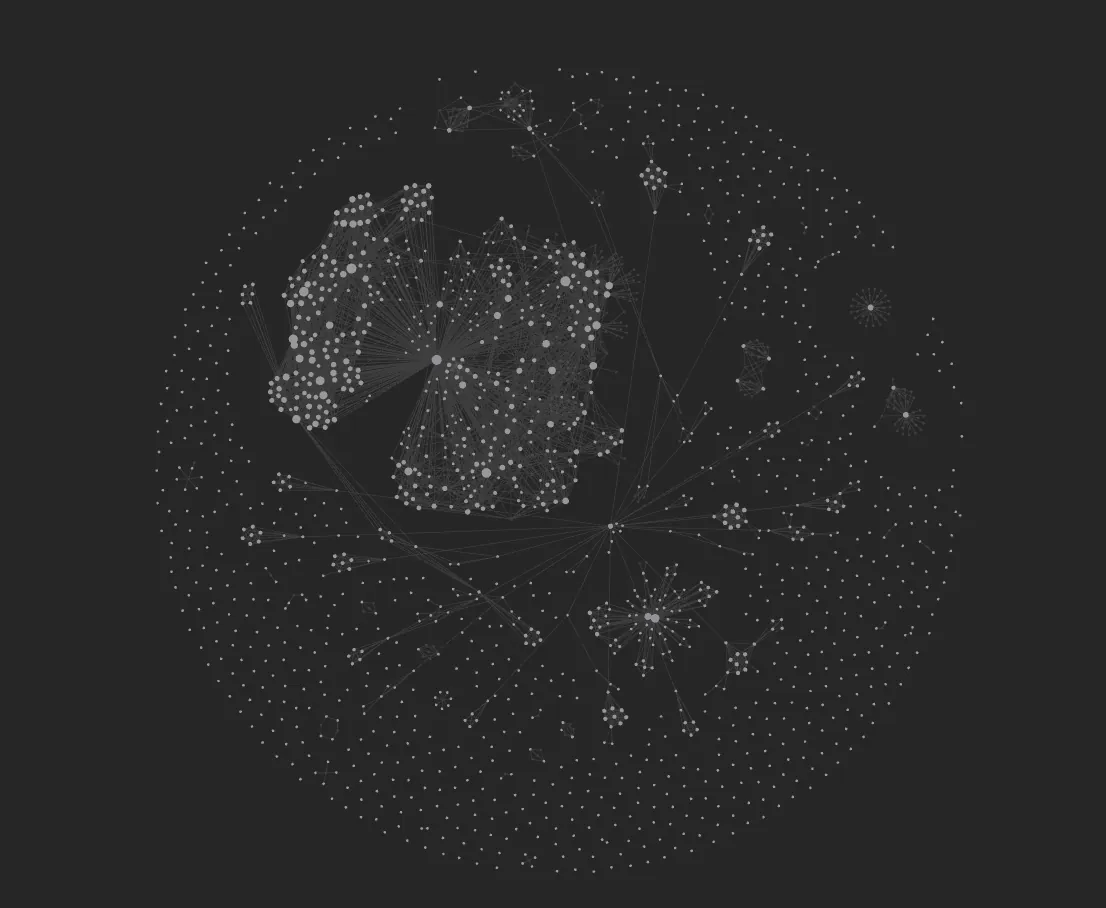
The building blocks are deliberately legible: notes, links and a knowledge format that can be inspected alongside the tools using it. The graph is a way to navigate those connections; the useful part is the information behind each node.

An unlabelled knowledge graph supplied as an illustrative reference, showing linked clusters and hub nodes on a dark background.
Illustrative graph reference supplied for this case study. It is not evidence of an employer implementation.

02 / The system pattern

Sources, connected knowledge, and rules for upkeep.

Karpathy’s LLM Wiki describes a useful pattern: keep source material, build an interlinked markdown wiki from it, and give the agent conventions for maintaining that wiki. Adding a source, answering a question and checking for stale or contradictory claims become explicit workflows.

Open Knowledge Format adds a way to describe context consistently. Its v0.2 trust signals can carry provenance, verification and freshness information, so a consumer can assess what it is about to use. Those fields describe trust; permissions still need to be enforced by the surrounding system.

03 / Proposed organisational extension

A shared asset that the business owns.

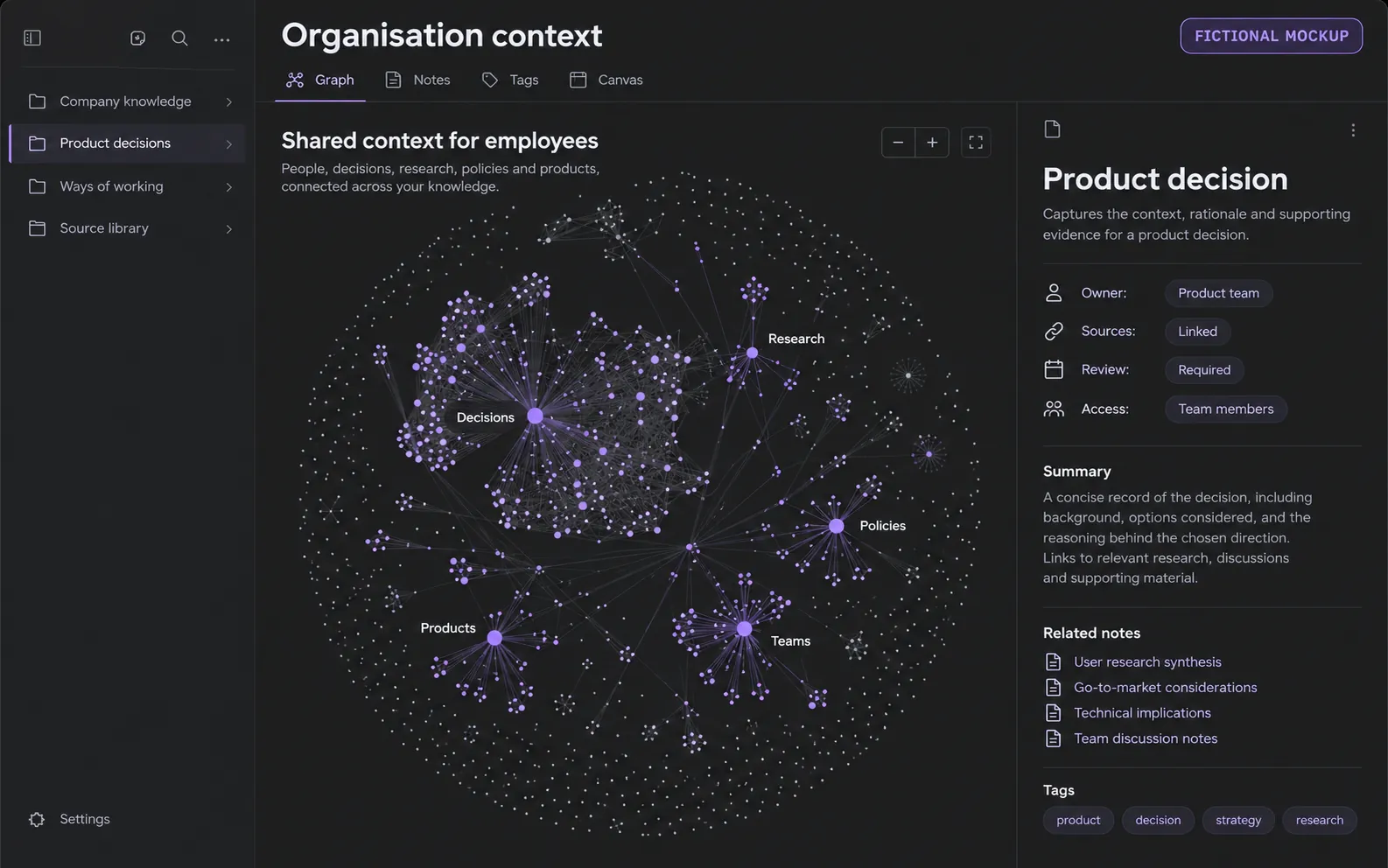
I think businesses should build organisationally owned and managed context systems for employees and their AI tools. Decisions, research, policies and ways of working should connect back to sources, with clear owners, review points and a traceable record of updates.

The ambition is continuity: a team should be able to reuse what the organisation has learned instead of rebuilding the same background for each new person or task. This is the broader product direction I see growing from the personal knowledge-system idea.

Fictional employee knowledge interface with a shared graph and a source-linked decision panel showing ownership, review and access fields.
AI-generated mockup An illustrative employee context system with fictional content. This is a proposed design, not a deployed employer system.

04 / Proposed client context

One relationship, with its history intact.

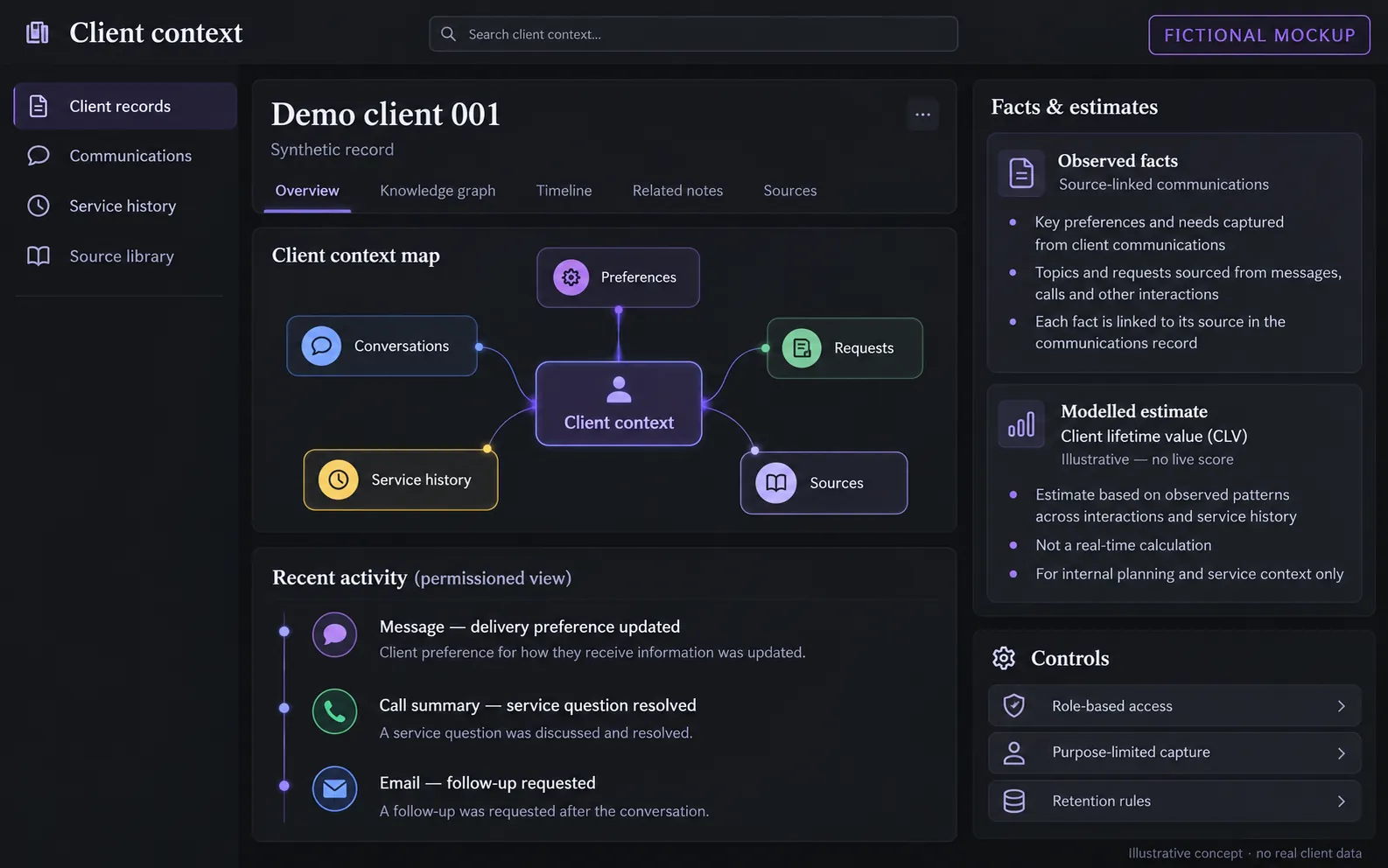
A permissioned context record for each client could bring together relevant communications, preferences, commitments and service history. Emails, messages and call summaries can support that view where their capture is appropriate and authorised.

Observed events and source-backed facts should remain separate from AI summaries and modelled estimates such as client lifetime value (CLV). Assumptions and freshness need to be visible. Ownership also means access controls, consent where required, purpose-limited capture, and retention and correction processes.

Fictional client record with a communications timeline, separately labelled facts and CLV estimate, and access and retention controls.
AI-generated mockup Synthetic client context demonstrating service continuity. No real client records, metrics or employer details.

Ideas informing the approach

Andrej Karpathy · LLM WikiA maintained, interlinked knowledge base built from source material. Google Cloud · OKF v0.2Optional provenance, verification, freshness and computation checks.

Experience

Five years in regulated product.

  1. Jul 2025 — presentToronto

    CIBC Investor’s Edge

    Senior Product Manager, AI & Personalization

    Product leadership in financial services.

  2. Oct 2023 — Jul 2025Toronto

    Trudell Medical International

    Manager, IoT & Intelligent Systems (Product Owner)

    • Owned the roadmap for AeroLiv, TMI’s first Software-as-a-Medical-Device platform and its connected IoMT respiratory ecosystem.
    • Negotiated and ran a $5M multi-year development contract, delivering compliant with FDA, Health Canada and CE Mark.
    • Brought launch forward a quarter through scope prioritization and QA automation, leading a distributed team of twelve across North America and India.
  3. May 2022 — Jun 2023London

    StoneX NASDAQ: SNEX

    Associate Product Manager, Global Trading Platforms

    • Product manager for the City Index and FOREX.com mobile apps, on platforms carrying roughly half of StoneX Retail’s global OTC CFD and spread-bet volume.
    • Drove a six-month quality initiative that cut iOS and Android crash rates by 99.58%, lifting retention and trade completion.
    • Shipped UX and packaging improvements to SMART Signals, the in-house ML trading-signals product, and ran UAT and A/B cycles on every new mobile build.
  4. Jun 2021 — May 2022London

    Equals Money LON: EQLS

    Product Analyst, Onboarding

    • Rebuilt B2B and B2C onboarding with automated KYC/KYB verification, lifting new-account conversion 35% and cutting approval from weeks to days.

Education

MA, International Studies & Diplomacy (Merit) · SOAS, University of London · 2021

MA (SocSci), Business & Management (2:1) · University of Glasgow · 2020 — Accenture-sponsored Open Banking (PSD2) research

Toolkit

What I work with.

AI & agents

  • Claude API
  • Claude Code & agent skills
  • Agent harnesses
  • Tool loops
  • SSE streaming
  • Evals
  • RAG / OKF knowledge bases
  • Hermes 4
  • Ollama
  • Mistral

Growth & data

  • Propensity modeling
  • A/B testing
  • Funnel optimization
  • Amplitude
  • FullStory
  • Google Analytics

Delivery

  • Prototyping
  • PR-FAQs & six-pagers
  • Jira
  • Confluence
  • Figma
  • Vercel
  • Next.js
  • Scrum

Contact

Let’s talk product.

Open to conversations about AI product work, agentic tooling and fintech. The fastest way to reach me is email.

That’s the tour

Thanks for reading.